
Backpacks are such emotional items. I have a friend who, for more than twenty-five years, used a beat-up, uncomfortable Boy Scout daypack for day hiking trips in Glacier National Park. I poked, prodded, and eventually pleaded for him to get a real daypack.
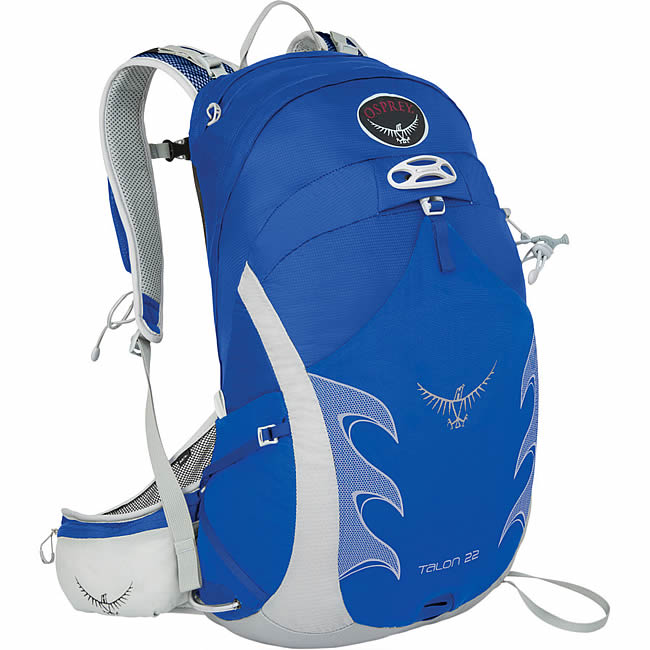 |
| An Osprey Talon Daypack. Hydration compatible and has an internal framesheet. If in doubt about what type of pack to get, go with Osprey Packs. View more Osprey Talon Backpacks at Amazon |
After a year of nagging, my friend finally broke down and bought a day pack designed specifically for day hiking.
The result? The strange emotional attachment he had with his old Boy Scout pack mysteriously vanished following the first hike with the new pack. The comfort, capacity, pockets, and ease of use of his new pack woke my friend up to how pleasant it is to hike using a daypack designed for serious day hiking.
So, if you are carting around an ill-fitting pack that fits like an upset monkey on your back, or if you are hiking with a “general daypack” not designed for serious day hiking, it is time to upgrade.
This article covers the following topics:
- Quick Summary - For those lacking desire to read this lengthy article.
- Daypacks for Serious Hiking - Technical Daypacks vs. General Daypacks
- The Two Most Important Features of Technical Daypacks
- How to Properly Size a Daypack
- Shopping Considerations
- Where to Buy Quality Daypacks for Hiking
Summary - What Type of Daypack to Use for Serious Day Hiking
If you’re shopping for a day pack for serious day hiking, here are some features I’d suggest the pack have:
- Internal Frame or Framesheet - The pack should have an internal frame or framesheet. The frame/framesheet helps shift the packs weight from the shoulders to the hips. On longer hikes, the ability to carry the packs weight “on the hips” is very important to prevent fatigue, sore shoulders and to improve balance.
- Hydration Compatible - The pack should be fully hydration compatible and accept either a 2-liter or 3-liter water bladder.
- Capacity - Get the smallest capacity daypack possible, based on your particular hiking needs. The smaller the packs capacity, the fewer items you’ll bring. A rough guide is to buy a pack with 1800 cubic inches or less of capacity. For most summer hikes (even in Montana), packs with 1200 cubic inches or less capacity usually work just fine. Only buy a larger capacity pack if you know for a fact you’ll need the space.
- Lightweight – The less the pack weighs the better. In general, try to buy a daypack that weighs 2.5 pounds or less (and the lighter the better).
- Backpack Sizing – Many daypacks are available in two sizes (small/medium and medium/large). Before buying a pack, read the sizing chart to insure that the pack is meant for your torso height. As a rough rule of thumb, hikers who are 5’ 4” or less will want to buy a small/medium pack, while hiker’s taller than 5’ 8” will prefer a medium/large pack.
- Good Brands of Daypacks - I use Osprey Packs for my hiking needs (in particular, I find the Osprey Talon excellent for most day hiking uses), but there’s plenty of other good brands available. Generally, you can’t go wrong buying packs made by TheNorth Face, Patagonia, Mountainsmith, Marmot, Black Diamond and Mountain Hardwear.
- Where to Buy - Amazon is the place to buy a daypack due to their massive selection and great prices. See below for quick links that lead directly to quality daypacks on Amazon's site.
Daypacks for Hiking - Technical Daypacks vs. General Daypacks
There are two styles of daypacks for hiking. Each of these daypack "styles" is profiled below.
General Daypacks
General daypacks, which are the most popular daypack, work well for most of life’s mundane tasks. They are fairly inexpensive, ideal for campus life, and work well for bike commuting and general travel. In short, they are excellent bags for “around town” and “around the city” use. The multitude of pockets allow for excellent organization, and the large capacities make it easy to bring everything but the kitchen sink when the need arises.
Yet, for day hiking—especially serious day hiking in the mountains or hikes that cover long distances—general daypacks pose many problems. In particular, these packs lack the durability, the adjustments, and—most importantly—the internal frame found in daypacks designed for serious hiking.
Although general daypacks will “haul the gear,” on longer day hikes these packs are much less comfortable than daypacks designed for serious day hiking.
Technical Daypacks
Recognizing general daypacks weren’t ideal for serious day hiking trips, manufacturers created smaller capacity packs with the same features found in full-size backpacks. While these smaller ability packs are still called “daypacks,” these packs are also known as “technical daypacks,” since they share the common technical features found in larger backpacks.
Features and design elements of technical daypacks rarely found in general daypacks include:
- Internal frame or framesheet
- Ability to carry a water bladder
- A larger main pocket designed to easily carry various sized outdoor gear
- Webbing on the outside of the pack to carry wet or awkward sized clothing items
- Numerous adjustment straps to allow for a more comfortable fit (especially sternum and riser straps)
- Increased durability
- Technical daypacks often weigh less than general daypacks with similar capacity ratings
The Two Most Important Features of Technical Daypacks
As mentioned, technical daypacks provide many features and design elements not found in general daypacks. Two features, however, are the most important—the packs internal frame and the ability to use a hydration bladder.
The Importance of the Internal Frame
Most technical daypacks have either an internal frame (usually made from one aluminum stay) or a lightweight framesheet built into the pack. A small number of technical daypacks lack an internal frame and are generally used by rock climbers.
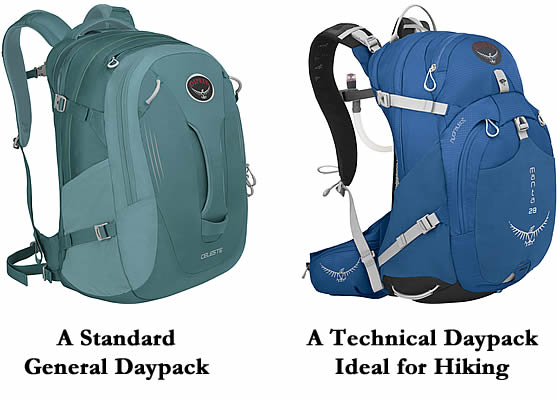 |
| A comparison of two similar capacity Osprey daypacks. The one on the left is a general use daypack and the one on the right is a technical daypack for hiking. |
Why is an internal frame so important? The internal frame allows the hiker to shift the packs weight off the shoulders and onto their hips. Generally, an internal frame pack allows 80%+ of the packs weight to “ride on the hips” instead of “riding on the shoulders.”
There are many advantages to having the packs weight ride on the hips. First, the hiker improves their balance. Instead of the pack constantly threatening to pull the hiker “backward,” with the weight riding on the hips a hiker maintains much better balance. This increased balance makes hiking off-trail or across rocky terrain much easier and safer.
A second benefit is reduced fatigue—in particular shoulder fatigue. A fifteen pound pack isn’t especially heavy. However, on longer hikes a fifteen pound pack often feels like a baby King-Kong after a few miles—especially if those miles require hiking uphill.
A third benefit to internal frame packs is the ability to customize the fit. An internal frame allows for infinite adjustments. In contrast, a pack without an internal frame has limited adjustments—none of which help much to improve balance or reduce fatigue.
In short, technical daypacks with internal frames are far more comfortable to use on longer day hikes than general daypacks.
The Water Bladder
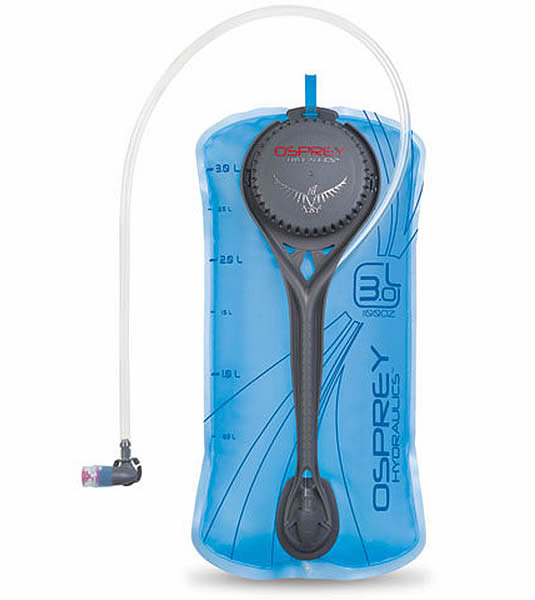 |
| An Osprey water bladder. Will slide into any "hydration compatible" technical daypack. View more Water Bladders at Amazon.Com |
Put simply, once you hike and use a water bladder, going back to generic 32 ounce water bottles is a “painful step back.”
For those not familiar with them, water bladders are large, flexible and durable water containers that slip between the backpacks main compartment and the packs fabric or framesheet. A long straw leads from the water bladder, where it’s attached to packs shoulder strap. To drink, the hiker just sips the straw.
Water bladders provide many benefits for hikers. In a separate article on this site I’ve listed the many benefits of water bladders.
Here's a quick summary of the benefits.
- Easy to Drink - When thirsty, just sip on the straw
- Less Bulk – Hydration bladders “shrink” as the hiker drinks from it. This greatly reduces bulk and increases the packs comfort.
- Easier Transport of Water - Since the water bladder fits in-between the pack and framesheet, the water lies vertically along the hikers back—making it much more comfortable to carry heavier amounts of water. Hikers also avoid having to stuff water bottles into every cranny of their packs—or worry about those bottles poking them in the back.
- Increase Packs Capacity - By not having to carry water in the main pack, a hiker increases the packs capacity to carry “other things.”
How to Size a Daypack
Most, but not all, day packs are available in two sizes—small/medium and medium/large. Small packs are for most women and shorter men, while large packs fit most men and taller women.
Before buying a pack, be sure to read the packs “sizing guide.” The sizing guide provides recommendations on which size pack to get, based on the person’s torso height.
An important note to remember—sizing guides change from manufacturer to manufacturer. Thus, the sizing guide for a North Face pack is different from the sizing guide for Osprey packs. To confuse matters further, the sizing guide often varies among packs made by the same manufacturer. For example, a small Osprey Talon daypack has a slightly different sizing guide than what’s used for the larger Osprey Stratos daypack.
While sizing guides differ from pack to pack, there’s still some broad “rules of thumb” that usually work when it comes to sizing daypacks (and larger backpacks). Anyone shorter than 5-4’ almost always wants a small pack. Anyone with a height of 5-4’ to 5-9’, will often find both sizes fit ok, although significant adjustments with the various straps might be needed to obtain a perfect fit. Finally, people taller than 5-9’ usually find the medium/large daypacks fit best.
But let me stress again—none of this is a solid rule. When shopping for a daypack, always check the sizing guide for a particular pack before buying it.
Shopping Considerations
Due to the sheer number of day packs available, it is easy to accidentally buy the wrong type of bag—or the right type of bag with the wrong features. To help hiker’s avoid this problem, here’s a checklist to follow.
Get the Right Size
Many, but not all, quality day packs are available in two sizes—small/medium and medium/large. While there are advantages to buying a “one size fits all” pack (mainly, it’s simpler), a pack designed for a specific height range often fits better than a “one size fits all” type pack.
Internal Frame or Framesheet
For any serious day hiking, any pack should have either an internal frame or a framesheet. The frame/framesheet allows the packs weight to ride on the hiker’s hip. Without a frame/framesheet, the full weight of the pack rests on the shoulders—making for a long day of hiking, especially if the hike is long.
Hydration Compatible
Any pack used for day hiking should either have its’ own hydration bladder or be fully “hydration compatible.” The pack should accommodate a 2-liter or 3-liter water bladder. Using a hydration bladder, instead of multiple water bottles, saves on weight and bulk. Hydration bladders also make it easier to stay hydrated while hiking.
Strap Adjustments
The more strap adjustments, the better. All daypacks have adjustable shoulder straps. And most daypacks have waist straps. However, technical daypacks offer other adjustments such as sternum straps and riser straps (riser straps are especially important since these straps help shift weight off the shoulders). Riser straps, however, are only found on packs that have an internal frame or use a framesheet.
How Much Capacity?
Unless you enjoy carrying heavy weight, there’s no reason to buy a larger capacity pack than absolutely necessary. With today’s ultralight and multi-functional gear, it’s simple to take long day hikes with packs that have 1000 cubic inches of capacity or less.
Remember, the pack utilizes a hydration bladder for water storage—thus freeing up the entire pack to carry other items. For general day hikes in summer weather, few hikers need a pack with a capacity greater than 1000-1200 cubic inches. An additional benefit of buying the smallest capacity pack possible is that the pack weighs less, and likely is more comfortable to carry, too.
Color
Choosing a packs color is a personal thing. Anyone shopping for a new daypack will discover today’s packs are available in a motley variety of colors and designs. Choose what’s best for you. Just remember the high visibility “fluorescent” colors many packs use is to assist rescuers in the unhappy event something bad happens.
Where to Buy Quality Daypacks
Due to their specialized nature, technical daypacks aren't as widely available as general use daypacks.
Offline, quality technical daypacks for hiking are sold at specialized outdoor sporting good stores. In particular, REI and Eastern Mountain Sports sell quality technical backpacks. Just be sure to buy the “right one,” since both stores throw their technical daypacks on the same shelves with general daypacks (and often, they look very similar).
Online, technical daypacks are widely available, which creates a small problem in figuring out where to start shopping for them. So let me make a suggestion—start at Amazon. The reason to begin at Amazon is simple - they offer the largest selection with usually the best prices.
The problem with Amazon, however, is that they sell so many packs (1000's) it is difficult to browse. So to help visitors find quality daypacks that are lightweight, hydration compatible and durable, I've created these links that show daypacks from the following quality manufacturers: Osprey, North Face, Kelty, Mountainsmith, Black Diamond, Marmot and Mountain Hardwear.
If still unsure which brand backpack to purchase, I suggest going with an Osprey pack. Osprey packs are durable, lightweight and specifically designed for demanding day hikes. In particular, the Osprey Talon, Stratos and Tempest packs are ideal packs for day hiking. I have two Osprey daypacks (along with a Osprey waistpack) and have no complaints. The Osprey Talon 22 is, in particular, an ideal backpack for day hiking.
Other online retailers that have a large selection of technical daypacks available include:
Prices for Select Osprey Talon Day Packs
I'm a huge fan of Osprey packs, and their Talon line are superb daypacks. Their packs are functional, comfortable, lightweight and exceptionally durable. They also have a superb warranty (lifetime).
Prices below are from several online merchants. To price compare, be sure to browse all Osprey packs at Amazon, too.