
Glacier National Park
Logging Lake

|
Glacier National Park
|
|
 |
| Home > Glacier National Park > Backcountry Lakes > Logging Lake | Search Site |
Backcountry Lakes
Glacier National Park
|
Logging Lake
|
 |
| Photo Use Guidelines |
Logging Lake is not the most visited place in Glacier National Park. Indeed, at times I wonder how many people actually come here at all. When I visited this lake on a busy summer weekend in August, the trail and the campground at the foot of the lake was completely deserted. As such, a hike up to Logging Lake is an excellent hike by someone in search of solitude.
Logging Lake is located in the North Fork region of Glacier National Park. Getting to the trailhead is sort of an adventure in itself, which probably explains the lack of people who use the trail. From West Glacier/Lake McDonald/Apgar area, to get to the trailhead requires going first down to the Fish Creek Campground (located on the north shore of Lake McDonald). From there, the road (called the Inside North Fork Road) turns to a bumpy, twisty and often dusty dirt road that makes its way over two small ridges, crossing Camas Creek and then Anaconda Creek in the process. The drive from the Fish Creek Campground is quite long - 20 miles - and since fast speeds are not possible, allow a good hour for the drive from Lake McDonald up to the trailhead that leads to Logging Lake.
The drive on the Inside North Fork Road up to the trailhead, once upon a time, was through very thick forests, offering few if any views. However, this part of Glacier National Park has seen some very busy fire activity here recently.
As such, the Inside North Fork Road sort of provides an education about forest fires and how fast nature can recover from them. Once you pull away from the Fish Creek Campground, the road first goes through the massive fire burn area caused by the Robert Fire in 2003. Then, without hardly a break, the road enters the huge fire scar caused by the Moose Fire in 2001, with Camas Creek itself marking the dividing line between these two fires. Beyond the Moose Fire scar, the road enters some forests for a time, before emerging into the Logging Creek Fire scar area, which burnt over in 1999.
After 20 miles of bumpy, dusty and rather educational driving, you finally reach Logging Creek and the patrol cabin that is there. The parking area for the Logging Lake Trail is located just on the north side of the bridge.
The Logging Lake Trail is a less than inspiring hiking trail, to be truthful. Like other hiking trails in the North Fork area, the Logging Lake Trail passes through thick forests for much of it's length - with the only real openings in the canopy occurring where the trail passes through a burn area. The trail itself is 12.8 miles in total length, and ends at a lake called Grace Lake. The trail information and photos on this page are from the hike I did up to the Lower Logging Lake Campground, which is 5 miles up from the trailhead.
 |
| Photo Use Guidelines |
From the trailhead, the trail begins a short but moderately steep climb up, gaining several hundred vertical feet in the process. Once done with the climb, the trail flattens out and emerges into the Logging Creek Fire scar area, and passes through it for more than a mile. Enjoy the views you get here, since they will be the last views you get until reaching the lake itself!
Beyond the fire scar area, the trail enters thick forest again. The trail in this area can be wet, boggy and buggy at times, depending on how much rain has been received and what time of year you are hiking. So, some prepared with some hiking boots that can get muddied up without a problem - and don't forget your mosquito repellent, either.
While you do not get any views when hiking on this part of the Logging Lake Trail, the good news is that the trail is by and large very flat, making for quick time. Only a handful of short, gradual, uphill climbs exist.
After 4.8 miles of this, you reach a unmarked spur trail that leads down to the Logging Lake Patrol Cabin. After 5.0 miles, you reach the side trail that cuts down to the Lower Logging Lake Campground. This is the most popular "destination" on this hike, as the campground itself provides for some great views of Logging Lake and the surrounding mountains.
The Lower Logging Lake Campground is a great place to go if you want to spend the night in the backcountry - and not be surrounded by a horde of people. Even during peak periods, this campground is normally open. 3 tenting spots are available at this campgroud - two of which are right on the lake.
 |
| Photo Use Guidelines |
The fishing in Logging Lake isn't bad. However, you really do want to have a boat with you if you want to catch the larger bull trout and lake trout that are found in this lake. The problem with Logging Lake is that much of the shoreline is very shallow. While you'll catch some small trout and whitefish along the shore, the larger bull trout and lake trout will be found out in the middle of the lake, usually down deep. As such, anglers in search of the larger fish will want to pack along either a float tube, an small inflatable raft or inflatable kayak. One of the newer "packable" pontoon boats would also work well on this lake, too.
It should be noted that the head of Logging Lake (the lake itself is about 4-5 miles in length, though not very wide) is closed to fishing due to eagle nesting.
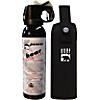
In the event you plan on camping overnight in the campground, be sure to bring your own water filter, as no well or spring is nearby - and you risk Giardia if you drink the water right out of the lake. Also don't forget to bring your bear spray, either, as the whole North Fork area is ripe with bears.
Bear spray is available through Amazon
Hiking Gear & Equipment Guide for Glacier National Park |
 |
Hiking Boots : Buyers guide to getting the right boot for hiking |
 |
Hiking Socks : Guide to getting the right sock for hiking |
 |
Trekking Poles : Why you should use one when hiking |
| Montana Web Cams | Montana Information | Fly Fishing Gear | Fishing Boats | About | Contact Us | Advertising Information | Privacy Policy |
.gif)