Fort Benton, Montana
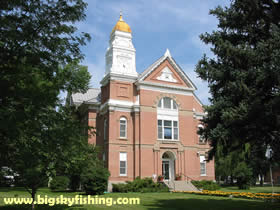
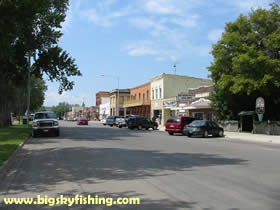
Fort Benton is a scenic and very nice little town located to the south of the Hi-Line. Truthfully, Fort Benton is probably not considered located on the Hi-Line, since it lies about 40 miles (as the bird flies) south of Highway 2. Still, Fort Benton is along the southern boundary of the Hi-Line region. Moreover, a side-trip off the Hi-Line down to Fort Benton is a worthy diversion, as Fort Benton has a great downtown, a scenic setting and is overflowing with history.
Fort Benton is a National Historic Landmark, and for good reason. Fort Benton was first explored by Lewis and Clark in 1805, who passed through here on their epic journey to the Pacific Ocean. After their passing, though, the area around Fort Benton continued to be only inhabited and explored by the Blackfeet Indians.
Then, beginning in the 1830’s, fur trappers made inroads in establishing some settlements in this region. However, a combination of poor town choices (several settlements were flooded out) and hostile Indians prevented the development of a full fledge town. Finally, in 1847, a new settlement called Fort Clay took root in the location that is now Fort Benton.
Fort Clay was re-named Fort Benton in 1850. The name change was to show support for Thomas Hart Benton, a US senator from the state of Missouri who was a constant supporter of the fur traders. By this time, the hostilities between the white settlers and the Blackfeet Indians started to thaw down a bit (prior to 1850, there were numerous skirmishes between the settlers and the Indians).
Fort Benton soon thrived as a center of trade. Indians arrived in Fort Benton with furs and hides, exchanging them to the white traders for guns, ammunition and other items. Fort Benton then served as a center of peace talks between the local Indian tribes and the white settlers, talks that concluded with a successful peace treaty in 1855. The peace treaty allowed for the US Government to builds roads and to navigate the Missouri River in exchange for annual annuity payments to the Blackfeet tribe. As part of this treaty, the Crow Indians were also granted buffalo hunting rights.
Following this treaty, the “boom” era around Fort Benton started. With navigation of the Missouri River insured, boats of all kinds made their way up and down the Missouri River, ferrying goods, pelts, furs and a wealth of other items. The first steamboat, the Chippewa, arrived in Fort Benton in July, 1860. As it turned out, the arrival of the steamboats to Fort Benton coincided with the discovery of gold in Southwest Montana. As such, the steamboats saw a booming business of transporting people and goods up and down the Missouri River. The town also thrived as the prospective miners stocked up on all the goods needed for a mining venture.
The “boom time” in Fort Benton proved short-lived. The decline in the mining boom led to a drop-off in people arriving in Montana. Then the Great Northern Railroad arrived in the late 1880’s. The railroad took over much of the freight moving traffic that the steamboats had. The last steamboat loaded with freight docked in Fort Benton in 1890.
Yet Fort Benton continued to have a solid economy. This was due to the Homestead Act and the resulting boom in agriculture that occurred throughout the Montana plains in the 1900’s – 1920’s. However, the Great Depression, followed by the consolidation of the agricultural industry, led to a weakening economy in the post World War II years, the same problems other eastern and central Montana towns faced.
However, Fort Benton, unlike many other prairie towns, became known for its recreational opportunities. A vast area to the east of town is known as the Missouri Breaks. Through this area, the Missouri River flows through essentially unchanged and completely wild country. This nearly unchanged area of Montana has recently become more well-known, and, combined with the renewed interest in Lewis & Clark, has allowed Fort Benton to prosper on the tourist trade.
Today, Fort Benton acts as the major “jumping off point” for people who will be floating the Missouri River through the Missouri Breaks area, an activity that has become much more popular recently. Additionally, the historic past of Fort Benton draws thousands of people downtown each year.
And finally, Fort Benton is also fortunate enough to be relatively close to a “major city”, which in this case is Great Falls. Over the past few years, people who work in Great Falls have been moving into Fort Benton to take advantage of living in an attractive small town, making the 40-mile commute. In some ways, it seems like Fort Benton may be destined, over the longer term, to become a “bedroom community” of Great Falls.
Overall, Fort Benton is a scenic little town, nestled along the banks of the Missouri River. Fort Benton is a great place to visit if you are looking to see a historic town in Montana. Additionally, Fort Benton is an ideal “base area” for anyone who will be venturing out into the wilds of the Missouri Breaks area.
To see more photographs of Fort Benton, visit the Fort Benton Photo Gallery page.
Next Page : The Bears Paw Mountains
Copyright 2002 - 2018 Big Sky Fishing.Com
|
|
|